Containment Is About People, Not Products
Containment: building trust, safety and the conditions for discovery
Containment might look like stainless steel, airlocks and pressure seals. What we are really building is trust, safety and the conditions for discovery. As new facilities come online, as risks evolve and as the workforce itself changes, the human side of containment will become more important. At PBSC, this perspective shapes everything we do. We specialise in bespoke solutions for BSL-3 and BSL-4 facilities and controlled environments because every project comes with unique challenges and behind each of those challenges are people relying on us to get it right.
The scale of containment work: who relies on these facilities?
The scale of containment work is substantial. In the UK alone, there are around 600 laboratories operating at BSL-3 level across universities, research institutes, private companies and NHS diagnostic facilities. Globally, more than 3,500 BSL-3 labs and over 100 BSL-4 facilities have been documented across 149 countries. Behind every one of these facilities is not just a building full of equipment but teams of scientists, technicians, engineers and safety officers whose daily work depends on the integrity of the environments around them. Containment is the invisible assurance that lets them focus on discovery, diagnosis and protection.
Operational responsibility: learning from incidents and reducing risk
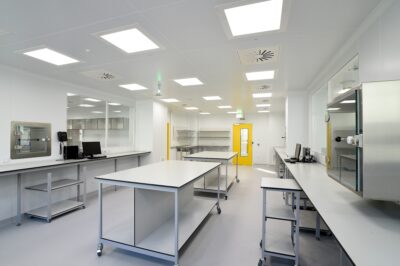
Between 2000 and 2021, researchers documented 309 laboratory acquired infections across 94 incident reports, including 16 incidents of pathogen escape from biocontainment labs. These were spread across 51 different pathogens, from common bacteria to high consequence viruses. While such incidents are rare compared with the volume of safe lab work, they are a powerful reminder that containment failures are not merely theoretical. Containment is, at its core, about reducing that risk to the lowest possible level. Engineering, training and oversight all play a part in ensuring that safe science is a daily reality.
Rapid facility growth vs governance: the oversight gap and its implications
We also know the world is building more high containment labs. Recent studies show the number of BSL-4 facilities has grown from 59 in 2021 to 69 across 27 countries, and there are now at least 57 BSL-3 enhanced laboratories in Europe adopting stricter measures than standard guidance. But growth in physical facilities has not always been matched by growth in governance. Researchers at King’s College London have warned that oversight, regulation and standardisation often lag behind. This raises a crucial point: the challenge is not only building safe environments but ensuring they are operated, maintained and governed in ways that reflect the risks.
PBSC’s integrated response: engineering safeguards, training and lifecycle service
PBSC addresses this gap by engineering safeguards into every solution. Our offering goes beyond equipment: we provide operator training, installation services, planned preventive maintenance, calibration and a variety of control options. Just as importantly, we support customers with bespoke design, rigorous testing and lifecycle service to ensure systems remain fit for purpose.
People at the centre: addressing skills shortages with usable systems
Even the most advanced equipment is only as effective as the people who operate it. Across the UK and Europe there is a growing skills shortage in laboratory staff, especially technicians. Many experienced professionals are retiring and the pipeline of new technical staff is not keeping pace. Some estimates suggest the UK alone will need 700,000 more technicians by 2030 across critical sectors including laboratory sciences. This shortage makes the human side of containment even more important. Systems need to be intuitive, reliable and designed with end users in mind.
Why bespoke engineering matters: tailored solutions that protect people and communities
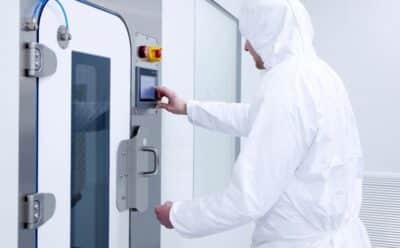
That is why bespoke engineering is more than a technical differentiator; it is a responsibility. A containment door or decontamination chamber is not simply a product to be installed; it is a safeguard for the people inside and for the communities beyond. By working closely with our customers, we design solutions that are fit for purpose and tailored to the specific risks, workflows and regulatory needs of each facility. When the stakes involve biosafety at the highest levels, one-size-fits-all is not enough. Learn more
Containment as a commitment to people and communities
In the end, containment is not about the steel we shape but about the people and communities it is designed to serve, and that will always remain our focus.
Disclaimer
PBSC designs and manufactures laboratory equipment to meet client specified requirements. PBSC does not provide regulatory advice or act as a compliance authority. Clients remain responsible for ensuring their operations meet applicable regulatory standards.